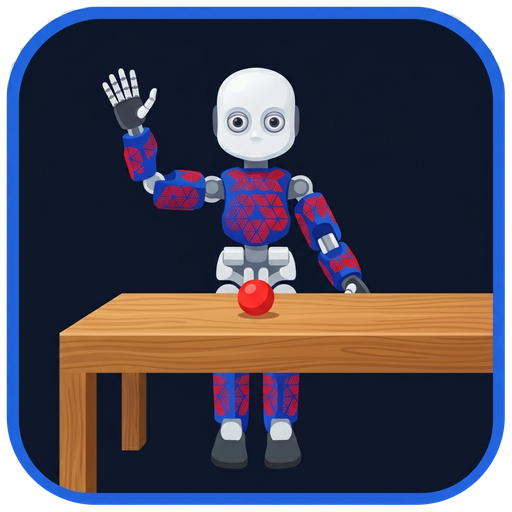
Teaching humanoid robotics often hits a tooling wall: real hardware like the iCub robot is rare and fragile, while research simulators frequently demand Linux-only ROS middleware and fragile setup steps before a student moves a single joint.
pyCub was created at the Czech Technical University in Prague to bridge that gap. Its core package, icub_pybullet, wraps PyBullet with accurate iCub kinematics, artificial skin ray-casting, stereo cameras, and reproducible YAML scenes.
pyCub Studio packages everything into self-contained binaries for Windows, macOS, and Linux (as well as pip packages) — letting 10-year-olds snap Blockly blocks in Czech or English, high-schoolers experiment with kid_api, and university classes debug Cartesian controllers with live RGB/Depth eye feeds.
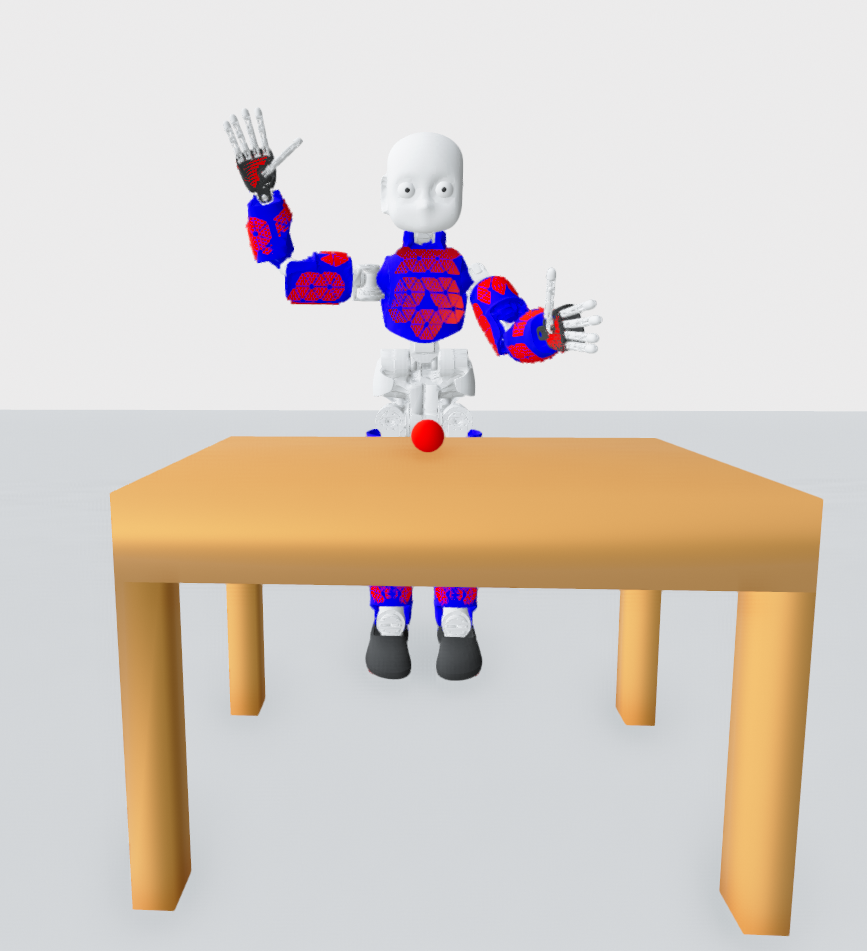
One consistent 3D robot from clickable buttons and Blockly up to low-level IK and sensor feedback.
Ready-to-run .exe, .dmg, .AppImage, and .deb packages plus pip wheels and browser QR classroom mode.
Full English & Czech experience across GUI, visual blocks, Python kid_api aliases, and handbooks.
Original code, handbook, and exercises are released under CC BY 4.0, while bundled robot models and runtime libraries retain their own open licenses.
Presented at the 17th International Conference on Robotics in Education (RiE 2026) · Springer
Department of Cybernetics, Faculty of Electrical Engineering, Czech Technical University in Prague
@inproceedings{rustler2026pycub,
  title={Learning with pyCub: A Simulation and Exercise Framework for Humanoid Robotics},
  author={Lukas Rustler and Matej Hoffmann},
  year={2026},
  booktitle={17th International Conference on Robotics in Education (RiE 2026)},
  organization={Springer}
} Original pyCub code, documentation, course exercises, and project-created meshes are released under Creative Commons Attribution 4.0 International (CC BY 4.0). Bundled third-party assets and standalone runtime dependencies remain under their respective open-source licenses:
All original Python/JS source code, docs/handbook sources, Course Exercises 1–5, and project-created meshes (icub_pybullet/other_meshes/).
URDFs, visual meshes, derived VHACD collision meshes, and skin taxel data from robotology/icub-models (v1.25.0).
Google / Raspberry Pi Foundation Blockly v10.4.3 bundles, localizations, and media (pycub_blocks.js and index.html remain CC BY 4.0).
Dynamically linked PySide6 / Qt 6 / QtWebEngine in onedir bundles (LGPL-3.0, Chromium LGPL-2.1), opencv-python (Apache-2.0 / FFmpeg LGPL-2.1), and permissive Python packages (MIT, BSD, zlib).